Winogradsky column lab page!


File:Icons-flag-uk.png
Welcome to the Winogradsky column lab page! Students from the Departments of Biological Applications and Technology, University of Ioannina and Icthyology and Aquatic Environment, University of Thessaly, Greece and the Microbiology course, Faculty of Sciences, University of Cádiz, Spain, discuss their findings on Winogradsky columns they constructed!

If you want to add a post, please feel free to contact the blog administrators (Hera Karayanni, Sokratis Papaspyrou or Kostas Kormas)!


Καλωσορίσατε στη σελίδα των Winobloggers! Διαδικτυακός τόπος συνάντησης φοιτητών, φοιτητριών και διδασκόντων δύο Τμημάτων από την Ελλάδα: Tμήμα Βιολογικών Εφαρμογών και Τεχνολογιών, Παν/μιο Ιωαννίνων και Τμήμα Γεωπονίας, Ιχθυολογίας και Υδάτινου Περιβάλλοντος, Παν/μιο Θεσσαλίας και ενός από την Ισπανία: Σχολή Θετικών Επιστημών, Πανεπιστήμιο του Cadiz. Παρακολουθούμε, σχολιάζουμε, ρωτάμε, απαντάμε σχετικά με τα πειράματά μας, τις στήλες Winogradsky!


Bienvenidos a la pagina web de los Winobloggers! Aquí los estudiantes y profesores de dos departamentos griegos, el Departamento de Aplicaciones y Tecnologías Biológicas de la Universidad de Ioannina y el Departmento de Agricultura, Ictiología y Sistemas Acuáticos de la Universidad de Thessalia, junto con los estudiantes de Microbiología de la Facultad de Ciencias en la Universidad de Cádiz, se reúnen para observar, comentar, preguntar y responder a preguntas relacionadas con nuestro experimento, la columna Winogradsky.


Winogradksy columns

Winogradksy columns
'In the field of observation, chance only favors the prepared mind' Pasteur 1854

Blog posts

Sunday, 26 April 2015

Winogradsky column. Biotechnology Group A8, UCA

Hello everyone!

This is the third time I write in this blog. I have some news about the changes that the bottle has experimented for these weeks.

First of all, the bottle has turned into a brown colour (it seems with sand's beach). The reason of this change could be that some of the bottle´s components have disappeared (it could be disappeared the iron sulfate, the pieces of paper or another component). But another possibility could be the sunlight, the oxygen or the carbon dioxide.

It could be possible that the microorganismes have caught the sunlight, the oxygen or the carbon dioxide because some of the components of the bottle have disappeared.

Here you have a photo that explained this change:
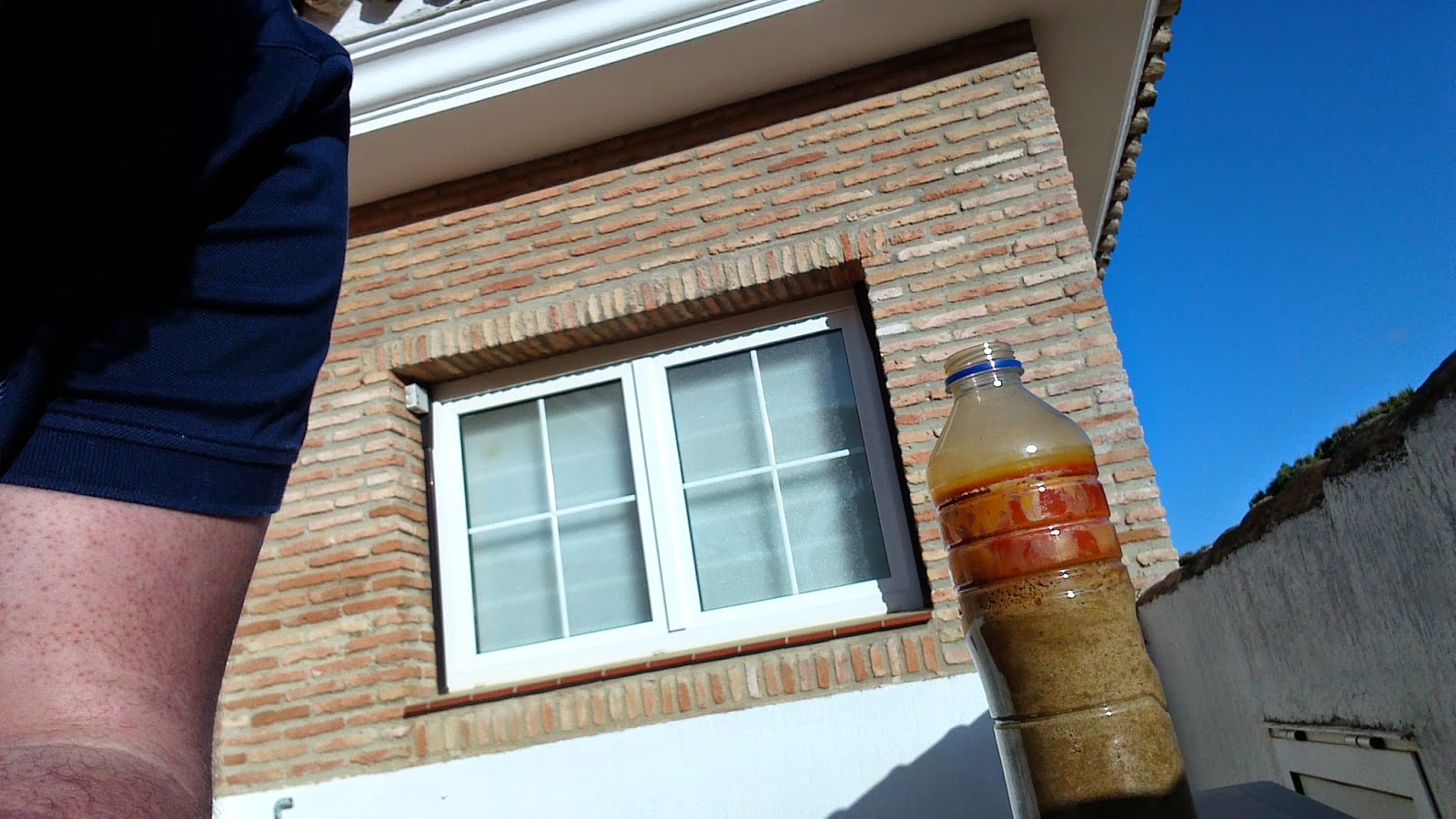

Here you have some photos which describe the evolution of the bottle:


Thursday, 23 April 2015

Winogradsky column, first post! B3

Hi everyone!

This is our first post about our Winogradsky column and what happened the first month.
Our column was made by sand from river San Pedro's beach, sand from the lake next to the river, starch, iron sulfate (FeSO4), calcium carbonate (CaCO3) and little pieces of filter paper used as carbon.
What we pretend to show is that our sediments are beneficial for sulfurous and ferrous bacterias to grow, as we can see because the color will change.
The first week, we observed that little mollusc were showing their faces, and that the column has started to being clearer.


In the 3th and the 4th weeks, the column didn't change too much because it was raining and the sky was cloudy, so there was no sun for the bacteries to grow. 
Luckily, finishing the 4th week the sun shined again and the column become more red because of the kind of bacteries that metabolise iron. 

The lasts weeks, the column has started to change visibly. The weather these last days had been really sunny and warm, so the column changed because of the heat and light. Looking at the colors, we can see that it has changed to a darker red, even the clear red that was perfectly visible the other week, has turned darker.

The bottom of the column is getting darker too and it seems like it is happening what we expected, anaerobian bacteries (dark colour) ferrous bacteries (red line).


Wednesday, 22 April 2015

Cadiz, 1A: WINOGRANDSKY COLUMN, SIXTH WEEK RESULTS

    Hello, winobloggers. We've got news! There's an important change in the bottle: seaweeds have appeared! 
    As you can observe in the photographs, seaweeds have appeared in the surface. It's due to the energy from the sun, oxygen and watter.
    Then, the other change is that orange areas are becoming bigger, so that black spots are disappearing. It's due to sulphur has been almost finished.

    There isn't many changes in the dark side of the bottle. 

 Light side of the bottle. 

Dark side of the bottle.

Seaweeds on the surface.

GROUP- 1A


Mastora Katerina  - Kritikos Thanos (Team 10).

We are a team of two people which have already started to practice above the Winogradsky column. In this column, we used a quantity of sediment and sea water from Anauros beach which is a region at the southwest of Volos.  The ingredients of our experiment were a quantity of sea water, an egg, pieces of paper,  a portion of sea water and at last an amount of milk.

INGREDIENTS OF MILK
The main ingredients of milk which have a connection with raise of microorganisms are:
v  Proteins, which characterize for the high biological value and supersede all other animal proteins except those of egg.
v  Sugars, such as lactose which it is not found nowhere else in nature in appreciable amounts except from milk.
v  Tallow(fat),which dominates in comparison with the other animal fats because it is more easily digested and contains a large proportion of unsaturated fatty acids.
v  Water in a quantity of 85%.
v  Salts, such as calcium and phosphorus in large quantities and magnesium, iodine and iron in smaller quantities.
The first result of the addendum of the fresh milk was the quickening of the experimental procedure.

●1st DAY
During the first day of our experiment, the column was sealed and placed in a bright place with relatively small temperature changes.

2nd DAY
During the second day, we noticed an increase in the turbidity of water. The turbidity caused to the increase of phytoplankton cells. As shown in the photo below shows a pale green colour. 


2nd DAY

●3rd -4th DAY
During the third and fourth day of our experiment, the turbidity of  water was reduced significantly and on the water surface has started to form  CaCO3. In this case, with milk and therefore the largest amount Ca, this phenomenon appears to occur quicker than in naturally conditions. The reduction of turbidity is caused by the fact that the HCO3 has presented  in the water, is no longer consumed by the cells of phytoplankton and forms CaCO3, in reaction Ca.


3rd & 4rth DAY


●5th – 6th  DAY
In the fifth day of our experiment we observed the creation of a black banding around the bottle . On the sixth day, the extent was  increased at a small rate and the colour was more intense. The black colour is caused by the presence of FeS (silica-mineral), which is formed anaerobically from the iron and sulfur reactions, as there is production of hydrogen sulfide.


5th – 6th  DAY